Technology is entering a period of change that could reshape nearly every part of modern life. Artificial intelligence is becoming more capable. Robots are moving beyond controlled factory environments. Scientists are developing new ways to edit genes, store energy, and create advanced materials. These developments are not isolated experiments anymore. Many are moving toward practical applications that could change how industries operate over the next decade.
The most important breakthroughs in future technology will not simply make existing devices faster or smaller. They may change how businesses produce goods, how doctors treat patients, how cities manage resources, and how people communicate. A manufacturing company could use intelligent machines to adjust production in real time. A hospital might identify disease risks earlier through advanced diagnostics. Energy providers could combine renewable electricity with better storage systems to improve reliability.
However, technological progress does not happen at the same speed everywhere. Some innovations are already being adopted, while others still face scientific, financial, and regulatory challenges. Businesses must separate realistic opportunities from exaggerated promises. The next decade will reward organizations that understand emerging technologies and prepare to use them responsibly.
Artificial Intelligence Moves From Assistance to Independent Action
Artificial intelligence is one of the strongest forces behind current technological change. Early business applications focused mainly on recognizing patterns, answering questions, and automating simple tasks. Newer systems are becoming more capable of planning activities, using digital tools, and coordinating several steps toward a defined goal.
This shift could influence nearly every industry. In finance, AI may help analysts review complex information and identify unusual transactions. In healthcare, it can support medical image analysis and help researchers organize clinical data. In manufacturing, intelligent systems can monitor equipment, predict maintenance needs, and improve production schedules.
The most significant breakthroughs in future technology may come when AI becomes part of complete business processes rather than remaining a separate application. However, greater autonomy also creates new responsibilities. Organizations must understand how systems make decisions, what information they use, and when human approval is necessary.
Agentic AI and the Rise of Autonomous Workflows
Agentic AI refers to systems designed to pursue goals through multiple steps. Instead of responding to one instruction and stopping, an AI agent may divide a task into smaller activities, use available software, evaluate results, and adjust its approach. For example, a business system might collect customer information, prepare a service response, update an internal record, and request human approval before completing a sensitive action.
This capability could change customer support, software development, procurement, and administrative work. A logistics company might use several specialized agents to monitor deliveries, identify delays, compare alternative routes, and recommend changes. A software team could use AI agents to review code, run tests, and identify possible defects before a developer approves the final release.
Yet autonomous workflows require strong controls. An agent can misunderstand an instruction, rely on incorrect information, or perform an action that creates financial or operational problems. Businesses should begin with limited tasks, clear permissions, activity logs, and approval points for important decisions. AI autonomy will create value when it improves productivity without removing accountability.
Smaller, Specialized Models Bring Intelligence Closer to Users
Large AI systems attract attention because of their broad capabilities. However, smaller models may become equally important for practical business applications. These systems are designed for specific tasks and can operate on phones, computers, industrial equipment, or local servers.
Running AI locally can reduce the need to send sensitive information to external services. It may also improve response times when an internet connection is unreliable. A factory machine, for example, could use a specialized model to identify unusual operating conditions without continuously transferring large amounts of data to a distant cloud platform.
This approach is especially useful in healthcare, manufacturing, transportation, and consumer electronics. A smartphone could process certain voice or image tasks directly on the device. A hospital might use a locally managed system to support administrative work while keeping information within approved infrastructure.
The limitation is that smaller models usually have less capacity than larger systems. Their performance depends on the quality of training data, hardware resources, and the complexity of the task. Organizations will need to choose between local processing, cloud-based intelligence, and hybrid systems according to their security and performance requirements.
Quantum Computing Could Change the Limits of Complex Problem-Solving
Traditional computers process information using bits represented as zeros and ones. Quantum computers use quantum bits, or qubits, which can take advantage of quantum effects such as superposition and entanglement. These properties allow certain types of calculations to be approached differently from conventional computing.
Quantum computing is not expected to replace ordinary computers. Its potential lies in specialized problems where quantum algorithms may offer advantages. Chemistry and materials science are important areas of interest because researchers want to model complex molecular interactions. Better simulations could support the development of new medicines, batteries, catalysts, and industrial materials.
Financial institutions and logistics companies are also exploring whether quantum approaches could help with selected optimization problems. These applications remain under development. A quantum computer does not automatically solve every complicated problem faster, and many proposed commercial uses still require significant technical progress.
One major challenge is error correction. Qubits are highly sensitive to environmental disturbances, which can introduce errors during calculations. Researchers are working to create more stable systems and practical methods for detecting and correcting these errors. Hardware scaling, operating costs, and the development of useful algorithms remain important obstacles.
Cybersecurity is another major consideration. Powerful future quantum computers could threaten some widely used public-key encryption methods. This has encouraged organizations to explore post-quantum cryptography, which is designed to resist attacks from both classical and quantum computers. Businesses that handle sensitive information over long periods should begin assessing their cryptographic systems rather than waiting for quantum computers to become commercially mature.
Biotechnology and Precision Medicine Enter a More Predictive Era
Biotechnology is changing how scientists understand and influence living systems. Advances in gene editing, molecular research, biological manufacturing, and medical diagnostics could make healthcare more targeted. Instead of relying only on broad treatment approaches, researchers are increasingly investigating ways to understand the biological characteristics of individual patients.
Gene-editing technologies such as CRISPR have created new possibilities for changing specific DNA sequences. Researchers are studying their use in inherited diseases, cancer treatment, and other medical conditions. Some gene-editing treatments have already reached clinical use for particular conditions, showing that the technology is moving beyond laboratory research. However, treatment access, long-term safety, cost, and eligibility remain important concerns.
AI is also influencing drug discovery. Pharmaceutical researchers can use computational systems to analyze biological data, identify possible drug targets, and examine candidate molecules. These tools may reduce some early research time, although laboratory testing and clinical trials remain essential. A promising computer prediction is not proof that a treatment will be safe or effective in people.
The effects may extend beyond hospitals. Synthetic biology could help create useful biological materials, produce specialized chemicals, and develop alternatives to certain industrial manufacturing processes. Agriculture may benefit from crops designed to tolerate environmental stress or resist specific diseases. Such developments could support food security, although ecological effects and responsible oversight must be considered.
Among the breakthroughs in future technology, biotechnology carries especially personal consequences. It can influence health, reproduction, food production, and the environment. Strong ethical standards, transparent research, and fair access will be essential if these advances are to benefit society.
Robotics and Physical AI Bring Automation Into the Real World
Robotics is moving beyond repetitive movements in carefully controlled industrial environments. Modern robots increasingly combine cameras, sensors, machine learning, and advanced control systems to understand their surroundings and respond to changing conditions. This combination is often described as physical AI.
Warehouses already use autonomous mobile robots to move products and support inventory operations. Manufacturing facilities use robotic systems for welding, assembly, inspection, and material handling. Newer developments aim to make machines more adaptable when objects, layouts, and working conditions change.
Humanoid robots receive considerable attention because their human-like structure could allow them to operate in spaces designed for people. They may eventually support selected tasks in warehouses, factories, laboratories, and other structured environments. However, handling delicate objects, navigating unpredictable spaces, and working safely near people remain difficult challenges.
Robotic systems could also influence healthcare. Surgical robots can help trained medical professionals perform certain procedures with precision and control. Rehabilitation robots may support movement exercises, while hospital delivery robots can transport supplies and equipment. These systems generally assist trained workers rather than replace the judgment and responsibility of medical teams.
The success of robotics will depend on more than impressive demonstrations. Machines must operate reliably, remain safe, and provide clear financial value. Businesses will also need to train workers to maintain, supervise, and work alongside automated equipment. The strongest applications may be those that remove dangerous or repetitive tasks while allowing people to focus on problem-solving and skilled work.
Clean Energy and Advanced Materials Reshape Industrial Infrastructure
The future of industry depends heavily on reliable and affordable energy. As electricity demand grows through digital infrastructure, transportation, manufacturing, and cooling systems, energy providers must improve how power is generated, stored, and distributed.
Battery technology is a major part of this transition. Improvements in energy density, charging speed, durability, and manufacturing costs could make electric vehicles and stationary energy storage more practical. Researchers are exploring solid-state batteries and other battery chemistries that may offer different combinations of safety, performance, and material availability. However, large-scale commercial success will depend on production quality, cost, supply chains, and long-term reliability.
Grid-scale storage is equally important. Solar and wind generation depend on weather and time of day. Storage systems can help save excess electricity and release it when demand increases or renewable generation falls. Smarter electricity networks can also use software and connected equipment to balance supply and demand more effectively.
Advanced materials may create another major shift. Researchers are developing lighter composites, more efficient semiconductors, improved insulation, and materials that can withstand extreme conditions. These developments could influence aircraft, electric vehicles, buildings, medical devices, and industrial equipment.
The breakthroughs in future technology in this area will depend on combining scientific advances with practical infrastructure. A highly efficient battery has limited value if it cannot be manufactured affordably or supported by suitable charging and recycling systems. Industrial progress will require cooperation among researchers, manufacturers, energy providers, and policymakers.
Spatial Computing and Connected Environments Change Human Interaction
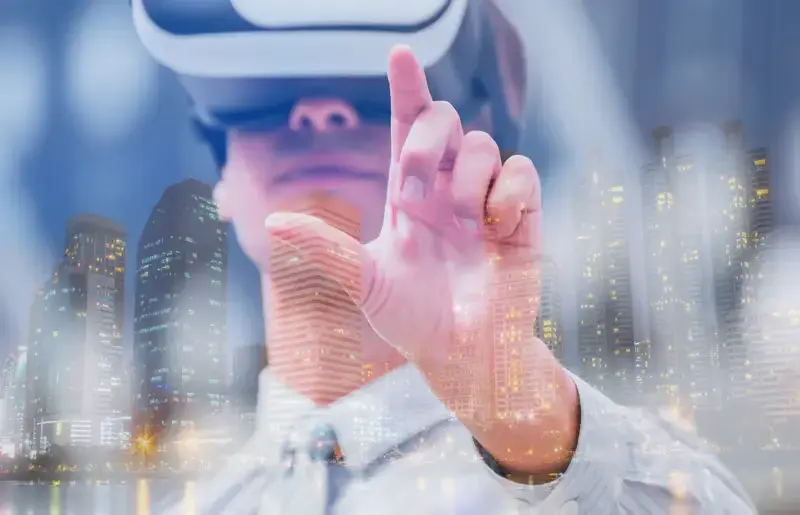
Spatial computing is changing how people interact with digital information. It combines technologies such as augmented reality, virtual reality, sensors, and three-dimensional interfaces to connect digital content with physical environments.
Augmented reality can place digital instructions or visual information over a real-world view. A maintenance technician might use smart glasses to see equipment diagrams while inspecting a machine. A medical student could study a three-dimensional model of human anatomy. An architect might examine a building design at realistic scale before construction begins.
Virtual reality offers a different experience by placing users inside a simulated environment. It can support training in situations that are expensive, difficult, or dangerous to recreate. Aviation, healthcare, industrial safety, and technical education are possible areas of application. Employees can practice procedures and develop confidence before performing them in real settings.
Digital twins extend the idea of connected environments. A digital twin is a virtual representation of a physical object, process, or system. It can use sensor information and operational data to reflect changing conditions. A factory may use one to test production adjustments. An energy company could model equipment performance and examine possible maintenance scenarios.
These technologies still face barriers. Headsets can be expensive or uncomfortable, and realistic simulations require accurate data. Businesses must also consider privacy when systems collect information about physical spaces and user behavior. Adoption will depend on whether immersive tools solve real problems more effectively than conventional screens and software.
The Industries Most Likely to Experience Major Disruption
Manufacturing is likely to experience significant change through robotics, predictive maintenance, digital twins, and intelligent quality control. Connected production systems can monitor equipment and identify problems before they cause costly interruptions. Advanced materials and more efficient energy systems may also change how products are designed and manufactured.
Healthcare could benefit from AI-supported diagnostics, personalized treatments, robotic assistance, and faster drug research. These technologies may improve the way professionals interpret information and coordinate care. However, patient safety, clinical evidence, data protection, and regulatory approval will remain essential.
Finance may use AI to improve fraud detection, risk assessment, customer support, and compliance monitoring. Quantum computing could eventually influence selected financial calculations, although practical advantages remain uncertain. Human oversight will remain important because financial decisions can have serious consequences for individuals and businesses.
Transportation may become more connected through autonomous systems, intelligent traffic management, electric vehicles, and advanced logistics software. Fully autonomous transport will require reliable performance in complex environments, suitable infrastructure, and clear legal responsibility.
Agriculture could use robotics, sensors, predictive analytics, and biotechnology to improve crop monitoring and resource management. Precision agriculture may help farmers apply water, fertilizer, and other inputs more carefully. Education and retail may also change through personalized learning systems, immersive experiences, intelligent customer support, and more responsive supply chains.
The speed of change will differ across sectors. Industries with strong digital infrastructure and clear financial incentives may adopt new tools earlier. Highly regulated fields may move more cautiously, particularly when public safety or sensitive information is involved.
Conclusion
The next decade could bring major changes through artificial intelligence, quantum computing, biotechnology, robotics, clean energy, advanced materials, and spatial computing. These technologies have the potential to reshape industries and create new ways to solve difficult problems. Their impact will depend on scientific progress, investment, infrastructure, skilled workers, and responsible regulation.
Businesses do not need to adopt every new innovation immediately. They need to understand which developments are relevant to their goals and prepare their people and systems for change. Individuals can benefit by building adaptable skills and remaining open to new ways of working.
The most important breakthroughs in future technology will not be measured only by processing power or impressive machines. Their real value will come from improving health, expanding opportunity, making industries more efficient, and solving problems that once seemed out of reach.